We just launched this interactive map with details about 2,294 homicides that occurred in D.C. between 2000 and 2011. You can find the killings in your neighborhood, follow the trends over time, and learn how the victims died and what happened to their cases.
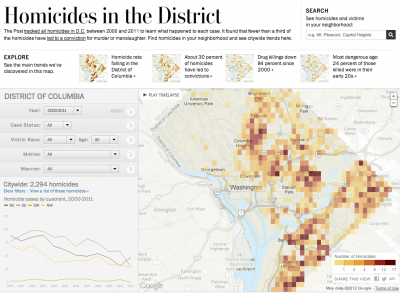
Key findings featured in the graphic:
Click the headline to jump straight to that view in the map.
Homicides in D.C. are down 55 percent since 2000
The number of homicides in the District fell last year to 108, a 49-year low. Despite the decline, homicide continues to be a tough crime to solve and prosecute in the city.
30 percent of homicides in D.C. led to convictions for murder or manslaughter
Of the 2,294 homicides that occurred in the District of Columbia between 2000 and 2011, 694 led to convictions for murder or manslaughter. At least 189 cases ended with administrative closures.
Motives: Drug killings down 84 percent
The most common motives for homicide in D.C. are arguments, drugs and retaliation. About 2 percent are classified as gang-related. Homicides involving drugs have decreased about 84 percent since 2000. Drug-related homicides accounted for eight of the city’s killings last year, compared with 49 in 2000.
Most dangerous age: 24 percent of those killed were in their early 20s
More than half of the District’s homicide victims between 2000 and 2011 were between the ages of 15 and 29. About 93 percent of those victims were male, and 94 percent were African American.
Kat Downs
October 15, 2012
Mapsandrew metcalf, dc, Design and infographics, google maps, graphics, investigations, Maps, serdar tumgoren, washingtonpost.com, Work
Read more >
The past several weeks have been full of foreign news, and we have been producing lots of graphics to explain what’s happening. I have worked on these two graphics, one about the earthquake and subsequent tsunami in Japan, and one that explains what is going on in Libya.
For a full explanation of the process of creating the Japan graphic, visit the new Innovations blog at the WP (excerpted below):
Friday morning, as news of the earthquake in Japan spread, we started pulling together an interactive map that would show readers where and how events unfolded. Over the next 36 hours, we would continually expand and improve the information, design and interactivity of the map as the news of the earthquake and tsunami came in. Read more »
For Libya, we combined an event tracker with audio and video from the ground. The reports from correspondents on the ground is my favorite part.
Both graphics are done using javascript and jquery, so check them out on your tablet devices!
Kat Downs
March 21, 2011
Information Graphics, Maps, Multimediaaudio, google maps api, graphics, javscript, Laris Karklis, Maps, Mary Kate Cannistra, Multimedia, Nathaniel Vaughn Kelso, news, The Washington Post, video, Work
Read more >
On Nov. 2, midterm election day, we put up these maps that tracked the results as they came in. For Senate and Governors we had state and county-level data, and we had House districts as well. This suite of maps was published in The Washington Post, as well as on Yahoo! News and the Telegraph (UK). The maps have balance of power charting and tabular results as well as zooming and deep linking features. Read more about how we built the maps »
Kat Downs
November 13, 2010
Mapsdemographics, Design and infographics, elections, fun, graphics, Maps, Nathaniel Vaughn Kelso, politics, The Washington Post, Work
Read more >
We published this graphic for Arbor Day, which was on April 30. It takes a look at all the trees that have been planted by the non-profit organization Casey Trees since 2003. They’ve planted thousands of trees in order to try to increase D.C.’s “urban canopy.” You can use this tool to see where they’ve planted trees in your neighborhood and what kind they are.
From a technical standpoint, this project was really interesting. It was executed in about two days, so it was a really quick turnaround, considering I haven’t done extensive development with the google maps api. Nathaniel and Gene worked up some cool custom tiles, and I designed and programmed a lot of it, and fit all the pieces together. Keep reading this post »
Kat Downs
May 17, 2010
Mapsenvironment, gene thorp, google maps api, Maps, Mary Kate Cannistra, Nathaniel Vaughn Kelso, nature, The Washington Post, Work
Read more >
These three new race maps (house, senate, and governors) launched today with the new PostPolitics section of The Washington Post. I worked with Karen Yourish and Dan Keating, who are absolutely amazing data whizzes, to get the data together for the project, and Nathaniel Vaughn Kelso gave me some great base maps to start with. We really wanted to give a complete picture of the 2010 races, so we have current race ratings (for house, we have state of the race), election history for each district or state, and demographic information that lets you see some cool patterns — like how states vote when they have a high percentage of seniors or high poverty rates. Keep reading this post »
Kat Downs
April 28, 2010
MapsDan Keating, Design and infographics, elections, graphics, interactive, Karen Yourish, Maps, Nathaniel Vaughn Kelso, politics, The Washington Post, Work
Read more >
I re-purposed the unemployment map for this story about ultra-high billing rates at skilled nursing facilities in the U.S. It shows where facilities are billing ultra-high rates. The Washington Post found that nursing homes have flooded ‘ultra-high’ billing categories with patients, and the amount of waste and abuse could reach billions of dollars a year. Check out the graphic or read the story by Scott Higham and Dan Keating.
Kat Downs
March 29, 2010
MapsDan Keating, health, interactive, Maps, politics, The Washington Post, Work
Read more >
After many months talking about how we wanted to produce a nationwide county map, we finally had a project come up that called for one with a quick turnaroud — one and a half days! With a great base map by Nathaniel Vaughn Kelso, I created this United States county map that shows unemployment from 2007-2009. This is an early version, so there’s a lot of improvements to make, but I think it’s a solid start, and I’m happy we turned it around as fast as we did. I used classes I created for the helicopters state map and the Virginia governor’s race map to make the build much easier.
D.C.’s unemployment rate was 12.1% in Oct. 2009 — really high. Macon County, where Franklin is, had an unemployment rate of 10.3%. We’ll keep adding to this map as time goes on, and I think it’ll be really interesting to see what happens with jobs and the economy over time.
Kat Downs
December 3, 2009
Maps, Workeconomy, Information Graphics, interactive, Maps, Nathaniel Vaughn Kelso, news, The Washington Post, Work
Read more >
This graphic looks at demographic changes in Virginia for the past 10 years. You can select a category to see demographics on the map, and roll over each county for details. This map reuses functionality I built out for the campaign finance map earlier this year. We’ll get a lot of use out of this map of Virginia in the future.
![[Map image]](../../../_1NI9wgirUFw/SucwgpHmSpI/AAAAAAAAAIs/lQwnCpmThN4/s400/Picture-1.png)
A state of change
Kat Downs
October 27, 2009
Maps, Workdemographics, Flash, Information Graphics, local, Maps, The Washington Post
Read more >

